Construction risk management software for UK builders
UK construction risk software spans enterprise registers, health and safety, schedule modelling, and document risk. See how each category maps by job and where CIM Build fits.
Construction risk management software spans 4 separate categories: enterprise and corporate risk registers, site health and safety (HSE and CDM) platforms, schedule risk modelling tools, and document and design risk software. UK commercial builders rarely rely on 1 tool for all 4 jobs because each category tracks different evidence and serves different teams.
As outlined in Procore's Construction Project Management Guide (Part 1, Chapter 2), construction risk management follows a clear cycle: identify risks, assess likelihood and impact, decide responses, assign ownership, and monitor new risks as project information changes. This guide focuses on document-driven commercial and design risk across tendering and delivery, while stating clearly which risk jobs belong to other systems.
Job matrix: UK construction risk categories and CIM Build's role
Map each risk job to its right software category before shortlisting vendors. The table below covers 7 common construction risk jobs, their typical system owners, and CIM Build's role.
| Risk job | What the job needs | Typical system owner | CIM Build role |
|---|---|---|---|
| Enterprise and corporate risk registers | Portfolio-level risk matrices, likelihood and impact scoring, and board governance reporting | Enterprise risk management (ERM) platform | Not covered |
| Health, safety, and CDM site management | RAMS, site inspections, hazard logs, incident reporting, and safety compliance records | Construction safety or field management software | Not covered |
| Schedule and delay risk modelling | Critical-path analysis, delay impact modelling, and quantitative schedule simulations | Scheduling and delay risk software | Not covered |
| Insurance and commercial exposure tracking | Subcontractor insurance cover, warranties, cash-flow exposure, and cost-to-complete forecasting | ERP, accounting, or compliance platform | Not covered |
| Cross-document requirement and report checks | Compare Employer's Requirements (ER), specifications, fire strategies, and acoustic reports against 2D drawings | Construction document review software | Does |
| Revision change detection | Surface unclouded graphic, dimensional, and text changes between transmitted drawing revisions | Drawing comparison or document review tool | Does |
| Document risk register and source-backed RFIs | Track cited findings with owner and status, and raise drafted RFIs tied to sheets and clauses | Project management platform or document review workspace | Does |
Enterprise risk scoring, site safety management, and schedule simulations stay in their dedicated platforms. Where commercial teams otherwise hunt through Employer's Requirements, specifications, consultant reports, and drawing revisions by hand, CIM Build's design risk management and revision tracking workflows extract written obligations, flag conflicts and unclouded changes across tendering and delivery, and draft cited RFIs for human review.
Worked example: lift shaft wall acoustic target (Australian project)
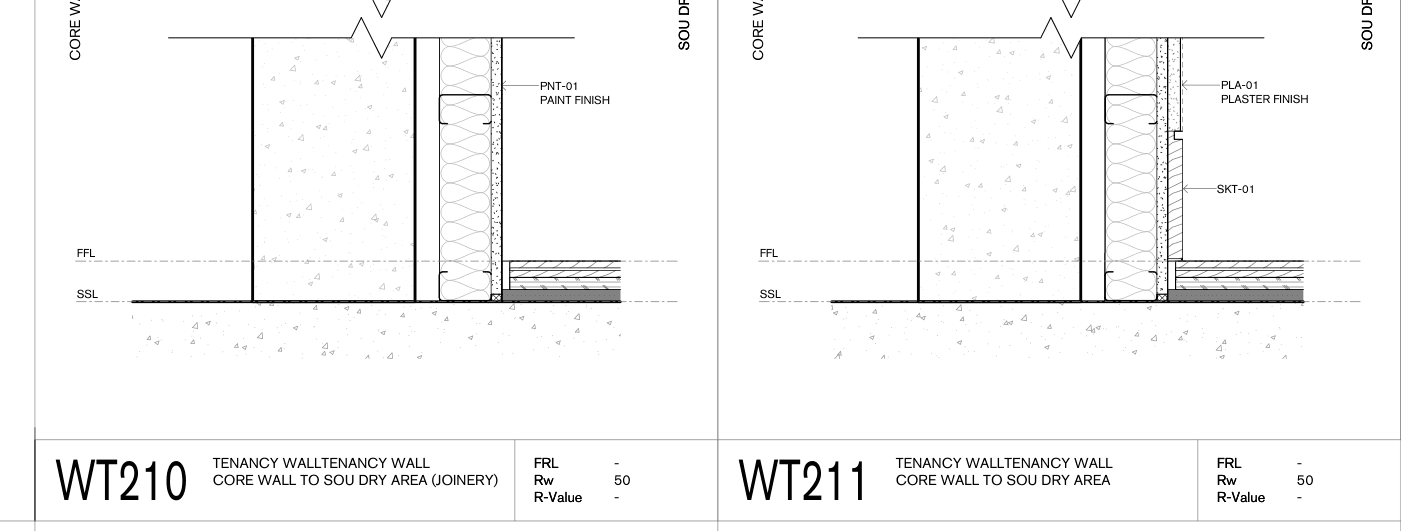
Illustrative reconstruction. This example comes from an Australian commercial project using National Construction Code (NCC) airborne sound insulation ratings (Rw). UK builders encounter the same cross-document gap whenever an acoustic report or Employer's Requirements sets a project performance target above statutory baselines while an architectural wall schedule keeps the lower build-up.
| Source requirement | Drawing and schedule | Discrepancy | Qualitative exposure | Next decision |
|---|---|---|---|---|
| Australian Acoustic Report Table 3 (p. 9): documented NCC minimum column lists Rw50 (Impact: Discontinuous) for dwelling-to-lift-shaft walls. Client-elected project requirement sets Rw65 (Impact: Discontinuous). | Wall Type Schedule A5711 and ground floor plans A1502 (east) and A1503 (west) schedule WT210 and WT211 at Rw50 along the lift shaft dwelling boundary | Scheduled Rw50 build-up matches the Australian NCC minimum column, below the client-elected Rw65 project requirement | Ordering or installing the Rw50 partition risks rework, acoustic re-testing, or a variation if Rw65 governs under the contract | Inspect the cited report table, wall schedule, and floor plans together, then raise an RFI before lining procurement to confirm whether Rw65 governs and obtain a coordinated WT210/WT211 build-up |
How CIM Build supports document-driven risk control
Commercial builders of any size use CIM Build to surface, assign, and close document risks in 3 steps:
- You load the active set and start a review: Upload 2D drawings, schedules, specifications, Employer's Requirements, and consultant reports, or connect project files through integrations. Formal issue and transmittal trails stay in your CDE or DMS, such as Oracle Aconex transmittals. Choose what to check across consultant report review, Employer's Requirements vs drawings, or revision tracking, and start the run.
- CIM Build extracts clauses and produces cited findings: CIM Build checks written requirements against drawings and schedules and marks cited regions on each PDF page with the clause, sheet reference, and finding outcome (Compliant, Non-compliant, or Cannot verify).
- Your team assigns owners, clarifies, and hands off: Estimators, quantity surveyors, and design managers track status and owners in registers and export findings to PDF (with cited source pages), Excel, or CSV. From any finding, a team member can raise an RFI in suggested RFIs: CIM Build drafts the question with the cited sheet and clause attached, and the reviewer edits, picks recipients, and sends it by email or, on a connected project, as Aconex project mail or a Procore RFI, with answers returning to the RFI. When revised documents arrive, a person refreshes the review while keeping finding IDs, statuses, and team edits.
What to check before choosing UK construction risk software
- Match software to the risk source: Keep health and safety, enterprise risk scoring, schedule modelling, and document review in tools built for those records.
- Require direct source links: For document risk, verify that every finding points directly to the sheet, revision, and report clause so reviewers can check it without hunting through PDFs.
- Keep machine findings separate from commercial calls: Confirm that a Cannot verify outcome triggers a human check of adjacent sheets or an RFI, and that your team decides contract precedence and allowances.
- Track through RFIs and revisions: Verify that document findings turn into drafted RFIs and carry forward across drawing revisions without losing history.
Frequently asked questions
Does CIM Build provide enterprise risk scoring or UK health and safety management?
No. Enterprise risk matrices, probability-impact scoring, RAMS, and site safety incident tracking stay in dedicated ERM and safety platforms. CIM Build focuses on document-driven design and commercial risks across drawings, schedules, specifications, Employer's Requirements, and consultant reports.
Does CIM Build certify fire strategy, acoustic, or regulatory compliance?
No. CIM Build places cited report and specification clauses beside drawing and schedule evidence to support technical review. The builder and specialist consultants remain responsible for compliance, document precedence, and sign-off.
What does a Cannot verify outcome mean?
Cannot verify means drawing or schedule coverage for a written requirement was not confirmed in the uploaded set. It prompts the reviewer to check adjacent sheets or raise an RFI.
Can teams issue RFIs directly from a risk finding in CIM Build?
Yes. A reviewer raises an RFI from the finding, CIM Build drafts the question with the cited sheet and clause attached, and the reviewer edits the wording, picks recipients, and sends it by email or, on a connected project, as Aconex project mail or a Procore RFI.
How is CIM Build priced for document risk review?
CIM Build is priced per project, and the project price is determined by the number of pages we process for that project. Contact CIM Build for a quote on your project.
Test document risk review on a live tender
Bring a representative tender pack with consultant reports, Employer's Requirements, and 2D drawings to see which cross-document risks surface before pricing. Contact CIM Build to run a live tender review.
Send us a live tender and see what it finds
Your first live tender project comes at a discount. We scope the review with you, run your drawings, schedules, and specifications, and walk through the evidence with your team. Get results in hours inside interactive software where your team can trace sources and verify every measurement and finding. Timing depends on pack size, document quality, and review scope.
Book a demoLeave your contact details first. Our team will follow up to arrange safe document sharing and a walkthrough.