Construction risk management software for US builders
US construction risk software spans enterprise registers, OSHA safety tools, schedule risk modelling, and document risk. See how each category maps by job and where CIM Build fits.
Construction risk management software covers 4 separate categories: enterprise and corporate risk registers, site safety (OSHA) and incident platforms, schedule risk modeling tools, and document and design risk software. US commercial builders rarely use 1 system for all 4 jobs because each category manages different records and serves different roles.
As outlined in Procore's Construction Project Management Guide (Part 1, Chapter 2), construction risk management follows a defined cycle: identify risks, assess likelihood and impact, decide mitigation actions, assign responsibility, and monitor for new risks as project documents evolve. This guide focuses on document-driven commercial and design risk across bidding and delivery, while stating plainly which risk jobs belong to other systems.
Job matrix: US construction risk categories and CIM Build's role
Separate the risk jobs your organization runs before comparing vendors. The table below maps 7 common construction risk jobs to their typical system owners and shows where CIM Build fits.
| Risk job | What the job needs | Typical system owner | CIM Build role |
|---|---|---|---|
| Enterprise and corporate risk registers | Portfolio-level risk matrices, probability and impact scoring, and executive reporting | Enterprise risk management (ERM) platform | Not covered |
| Site safety (OSHA) and incident management | JHAs, site safety inspections, hazard logs, OSHA incident records, and field compliance | Construction safety or field management software | Not covered |
| Schedule and delay risk modeling | Critical-path analysis, delay impact modeling, and quantitative schedule simulations | Scheduling and schedule-risk software | Not covered |
| Insurance and financial exposure tracking | Subcontractor COI tracking, bonding, cash-flow exposure, and cost-to-complete forecasting | ERP, accounting, or compliance platform | Not covered |
| Cross-document requirement and report checks | Compare owner requirements, technical specifications, and consultant reports against 2D drawings and schedules | Construction document review software | Does |
| Revision change detection | Identify unclouded graphic, dimensional, and note changes between issued drawing revisions | Drawing comparison or document review tool | Does |
| Document risk register and source-backed RFIs | Track cited findings with owner and status, and raise drafted RFIs tied to sheets and clauses | Project management platform or document review workspace | Does |
Enterprise risk scoring, OSHA safety management, and schedule simulations stay in their dedicated platforms. Where commercial teams otherwise hunt through owner requirements, specifications, consultant reports, and drawing revisions by hand, CIM Build's design risk management and revision tracking workflows extract written obligations, flag conflicts and unclouded changes across bidding and construction, and draft cited RFIs for human review.
Worked example: lift shaft wall acoustic target (Australian project)
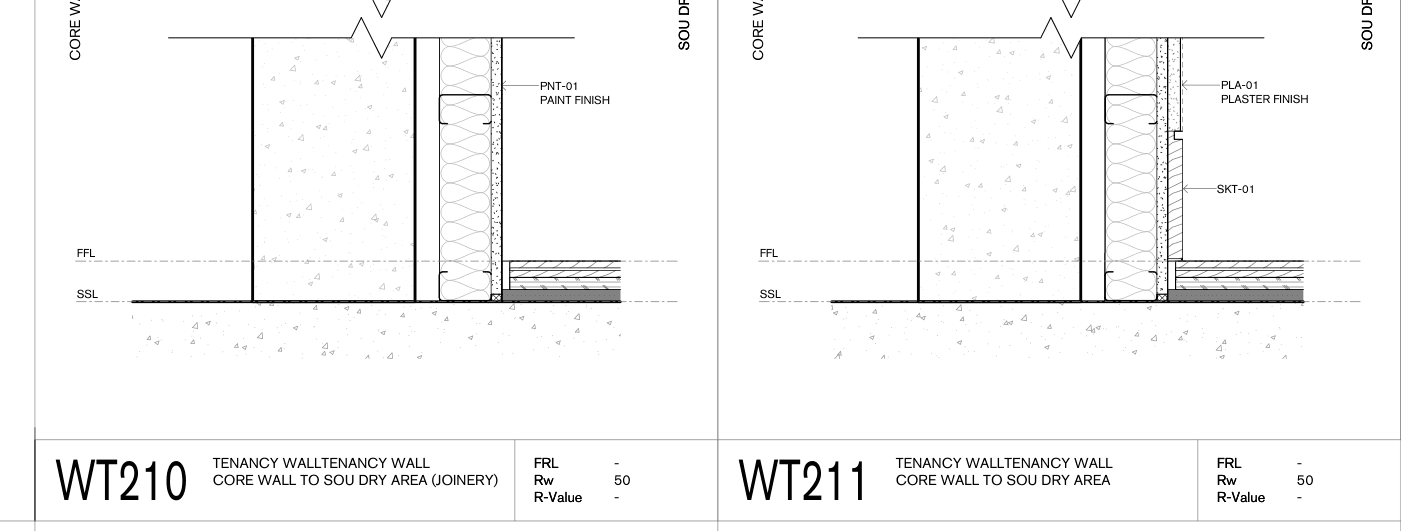
Illustrative reconstruction. This example comes from an Australian commercial project using National Construction Code (NCC) airborne sound insulation ratings (Rw). US builders face the same cross-document gap whenever an acoustic report or owner requirement sets a Sound Transmission Class (STC) project target above code minimums while the architectural partition schedule keeps the lower assembly.
| Source requirement | Drawing and schedule | Discrepancy | Qualitative exposure | Next decision |
|---|---|---|---|---|
| Australian Acoustic Report Table 3 (p. 9): documented NCC minimum column lists Rw50 (Impact: Discontinuous) for dwelling-to-lift-shaft walls. Client-elected project requirement sets Rw65 (Impact: Discontinuous). | Wall Type Schedule A5711 and ground floor plans A1502 (east) and A1503 (west) schedule WT210 and WT211 at Rw50 along the lift shaft dwelling boundary | Scheduled Rw50 assembly matches the Australian NCC minimum column, below the client-elected Rw65 project requirement | Ordering or framing the Rw50 partition risks rework, acoustic re-testing, or a post-award change order if Rw65 governs under the contract | Inspect the cited report table, wall schedule, and floor plans together, then raise an RFI before drywall procurement to confirm whether Rw65 governs and get a coordinated WT210/WT211 assembly |
How CIM Build supports document-driven risk control
Commercial builders of any size use CIM Build to surface, assign, and close document risks in 3 steps:
- You load the active set and start a review: Upload 2D drawings, schedules, specifications, owner requirements, and consultant reports, or connect project files through integrations. Formal issue and transmittal trails stay in your DMS, such as Oracle Aconex transmittals. Choose what to check across consultant report review, owner requirements vs drawings, or revision tracking, and start the run.
- CIM Build extracts clauses and produces cited findings: CIM Build checks written requirements against drawings and schedules and marks cited regions on each PDF page with the clause, sheet reference, and finding outcome (Compliant, Non-compliant, or Cannot verify).
- Your team assigns owners, clarifies, and hands off: Estimators, preconstruction managers, and project managers track status and owners in registers and export findings to PDF (with cited source pages), Excel, or CSV. From any finding, a team member can raise an RFI in suggested RFIs: CIM Build drafts the question with the cited sheet and clause attached, and the reviewer edits, selects recipients, and sends it by email or, on a connected project, as a Procore RFI or Aconex project mail, with answers returning to the RFI. When addenda or revised sheets arrive, a person refreshes the review while keeping finding IDs, statuses, and team edits.
What to check before choosing US construction risk software
- Match software to the risk source: Keep OSHA safety, enterprise risk scoring, schedule modeling, and document review in systems built for those workflows.
- Verify direct source citations: For document risk, confirm that every finding links directly to the sheet, revision, and specification or report clause for fast verification.
- Keep machine findings separate from commercial judgment: Confirm that a Cannot verify outcome triggers a human check of adjacent sheets or an RFI, and that your team controls contract precedence and pricing allowances.
- Maintain continuity through RFIs and addenda: Check that document findings turn into drafted RFIs and persist across drawing revisions without losing review history.
Frequently asked questions
Does CIM Build provide enterprise risk scoring or OSHA site safety management?
No. Enterprise risk matrices, probability-impact scoring, JHAs, and OSHA incident tracking stay in dedicated ERM and safety platforms. CIM Build focuses on document-driven design and commercial risks across drawings, schedules, specifications, owner requirements, and consultant reports.
Does CIM Build certify building code, fire, or acoustic compliance?
No. CIM Build places cited report and specification clauses beside drawing and schedule evidence to support technical review. The builder and design consultants remain responsible for compliance, document precedence, and sign-off.
What does a Cannot verify outcome mean?
Cannot verify means drawing or schedule coverage for a written requirement was not confirmed in the uploaded set. It signals a gap to check across adjacent sheets or clarify through an RFI.
Can teams issue RFIs directly from a risk finding in CIM Build?
Yes. A reviewer raises an RFI from the finding, CIM Build drafts the question with the cited sheet and clause attached, and the reviewer edits the wording, chooses recipients, and sends it by email or, on a connected project, as a Procore RFI or Aconex project mail.
How is CIM Build priced for document risk review?
CIM Build is priced per project, and the project price is determined by the number of pages we process for that project. Contact CIM Build for a quote on your project.
Test document risk review on a live bid
Bring a representative bid set with consultant reports, specifications, and 2D drawings to see which cross-document risks surface before pricing. Contact CIM Build to run a live bid review.
Send us a live bid set and see what it finds
Your first live bid project comes at a discount. We scope the review with you, run your drawings, schedules, and specifications, and walk through the evidence with your team. Get results in hours inside interactive software where your team can trace sources and verify every measurement and finding. Timing depends on pack size, document quality, and review scope.
Book a demoLeave your contact details first. Our team will follow up to arrange safe document sharing and a walkthrough.