
 Procore
 Autodesk Construction Cloud
 Aconex
 SharePoint
 Google Drive
 Outlook
Alternatives to Primepoint AI: Construction AI Options
Primepoint reads drawings as connected systems and flags clashes and gaps - genuinely capable. The real question is what you check at each documentation gate. Here's how CIM.BUILD differs, and where the other alternatives fit.
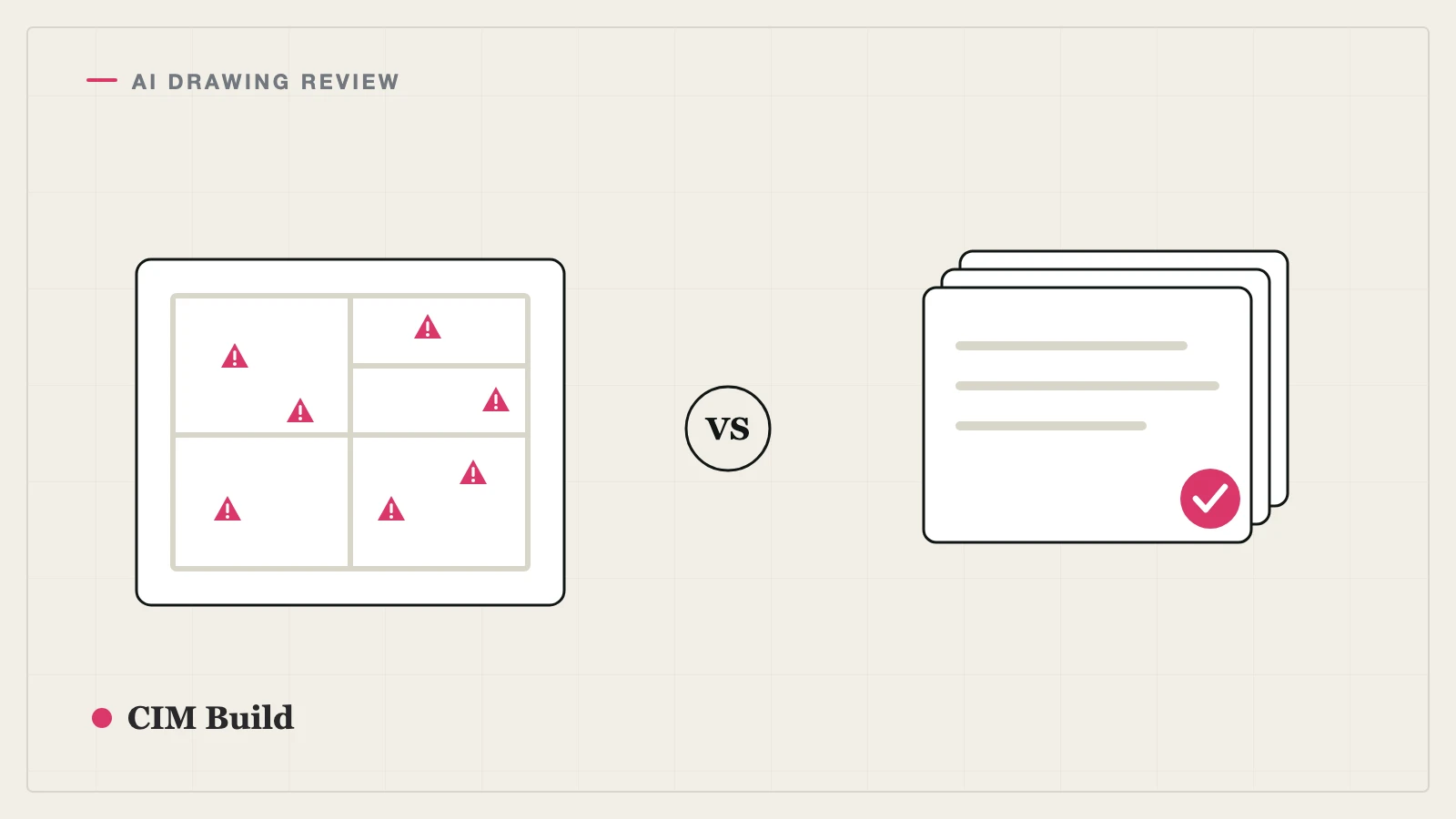
Primepoint is one of the most capable drawing-native AI platforms going. Its tagline - "construction intelligence, built on drawings" - is a fair description. It reads plans, specs and schedules as interconnected systems, uses a construction knowledge graph to link a door tag to its schedule and a submittal to its spec, and runs a constructability review that flags clashes, missing information and design gaps. It also handles submittal review, RFIs (Ask Marvin and the RFI assistant), revision narratives and discipline overlays. Of the AI checkers, it's the closest to what CIM.BUILD does.
So the honest comparison isn't "who reads drawings better". Primepoint reads them very well, and across documents, not one at a time. It's a question the feature list doesn't answer: are you checking the right things for the stage the documents are actually at?
The difference that matters: what you check changes at every gate
A concept set, a design-development set, a tender set and an IFC set are different animals. What counts as a defect changes at every gate.
Flagging "the door schedule doesn't match the hardware spec" at concept is noise
- the hardware schedule isn't done yet, and isn't meant to be. Flagging the same thing at IFC is critical: that's a gap that's about to be built. A review that applies the same lens at every stage gets it wrong in both directions. It buries the team in false positives at the early gates, and by the time the documents reach IFC - when the checks actually matter - everyone has learned to scroll past the alerts.
Same checks every time isn't rigor. It's noise. And a tool that cries wolf at 50% gets switched off by IFC.
Builders already know this. A good design manager checks for completely different things at design development than at tender than at IFC. The skill was never detection - it's knowing what to look for at each level of documentation. That's what CIM.BUILD is built around.
How CIM.BUILD is built around the gates
Same audit engine, different audit set, matched to the maturity of the documents:
- At tender - scope completeness for pricing. Is everything an estimator needs to price actually here, and where are the gaps, exclusions and ambiguities? Catching them at bid gives a far larger mitigation window than catching them on site - time to price the real scope and raise RFIs before award, when issues are cheapest to resolve.
- At design development - is the design intent coordinated at the level it should be? Major clashes and structural-vs-architectural fit, not the fine detail that isn't resolved yet.
- At IFC - full coordination: drawing-to-schedule consistency (doors, windows, finishes, hardware), services vs structure, standards compliance (AISC 360, the IBC), and any un-clouded changes since the last issue.
You get signal at every gate, not the same net thrown at documents that aren't ready for it.
Built for D&C builders, not the GC
The other real difference is who each tool is built for. Primepoint is aimed at leading contractors across preconstruction to closeout - largely the US GC market, building to documents someone else is liable for. CIM is built for D&C builders, who carry the design risk themselves. So the workflow is shaped around the people who own that risk: the estimator catching scope gaps at tender, the delivery PM comparing revisions, and the design manager producing a change register that proves which design obligations the consultants met. The deliverable isn't a flag in a viewer - it's a findings register and change register linked to source pages.
The other alternatives
Trunk Tools - A broader admin-automation suite (field Q&A, submittals, RFIs, bid scope) rather than a focused drawing audit. (See Alternatives to Trunk Tools.)
LightTable - A fast AI peer-review tool for design QA, optimized for finding more issues across review cycles. (See Alternatives to LightTable.)
Bluebeam Revu / Adobe Acrobat - If what you want is faster markup and takeoff on a single sheet, a per-user PDF tool does that directly. (See Bluebeam Revu Alternatives.)
Procore (with Procore AI) - If Procore is your system of record, Procore AI adds search and admin automation over RFIs, submittals and project records.
Document Crunch - AI focused on contracts and compliance, reading contract and spec language to flag risk and obligations.
How they compare
| Primepoint | CIM.BUILD | |
|---|---|---|
| Built for | Drawing-native intelligence for contractors | Stage-aware design audit for D&C builders |
| Strength | Reading drawings as a connected system (knowledge graph) | Matching the audit to the documentation stage |
| Reviews | Constructability, submittals, RFIs across the set | Stage-appropriate audits: scope-for-pricing at tender, full coordination at IFC |
| Built around | Preconstruction to closeout, for the GC | The D&C workflow: estimating, delivery, design management |
| Output | Flags, revision narratives, overlays, drafted RFIs | Findings and change register with source-linked citations |
| Best for | Drawing intelligence across the project | The right checks at the right gate, for the team that carries design risk |
How to choose
Primepoint and CIM are the two closest tools in this space, and if your priority is drawing intelligence in a viewer - clashes and gaps surfaced on the set in front of you - Primepoint is genuinely strong at it. If your priority is a review that's matched to the stage of documentation, and a change register your design management team can stand behind, that's the specific thing CIM.BUILD is built for - and it's built around the D&C builder who carries the design risk, from tender through delivery.
Frequently asked questions
What does Primepoint do?
Primepoint is a drawing-native construction AI platform. It reads drawings, specs and schedules as a connected knowledge graph, runs a constructability review that flags clashes, missing information and design gaps, and handles submittal review, RFIs (Ask Marvin) and revision narratives. It's aimed at contractors from preconstruction through closeout and integrates with Procore and Autodesk Construction Cloud.
How is CIM.BUILD different from Primepoint?
Both read drawings across documents and surface clashes and gaps. The difference is two things: CIM runs stage-appropriate audits - checking different things at concept, design development, tender and IFC, rather than the same review on every set - and it's built around the D&C builder's workflow, producing a change register that proves which design obligations were met.
Why does running the same checks every time matter?
Because it produces noise. Flagging a drawing-to-schedule mismatch at 50% design is a false positive - the schedule isn't finished. Flag enough false positives early and the team stops trusting the tool by the time the documents are at IFC, which is exactly when the checks count.
What's the best alternative to Primepoint?
It depends on the job. For stage-aware design audit built for D&C builders, CIM Build. For broad admin automation, Trunk Tools. For markup and takeoff, Bluebeam Revu. For contract and compliance review, Document Crunch.
Can I use both?
Yes. Some teams run a drawing-intelligence tool and a stage-aware design audit side by side; they emphasize different things.